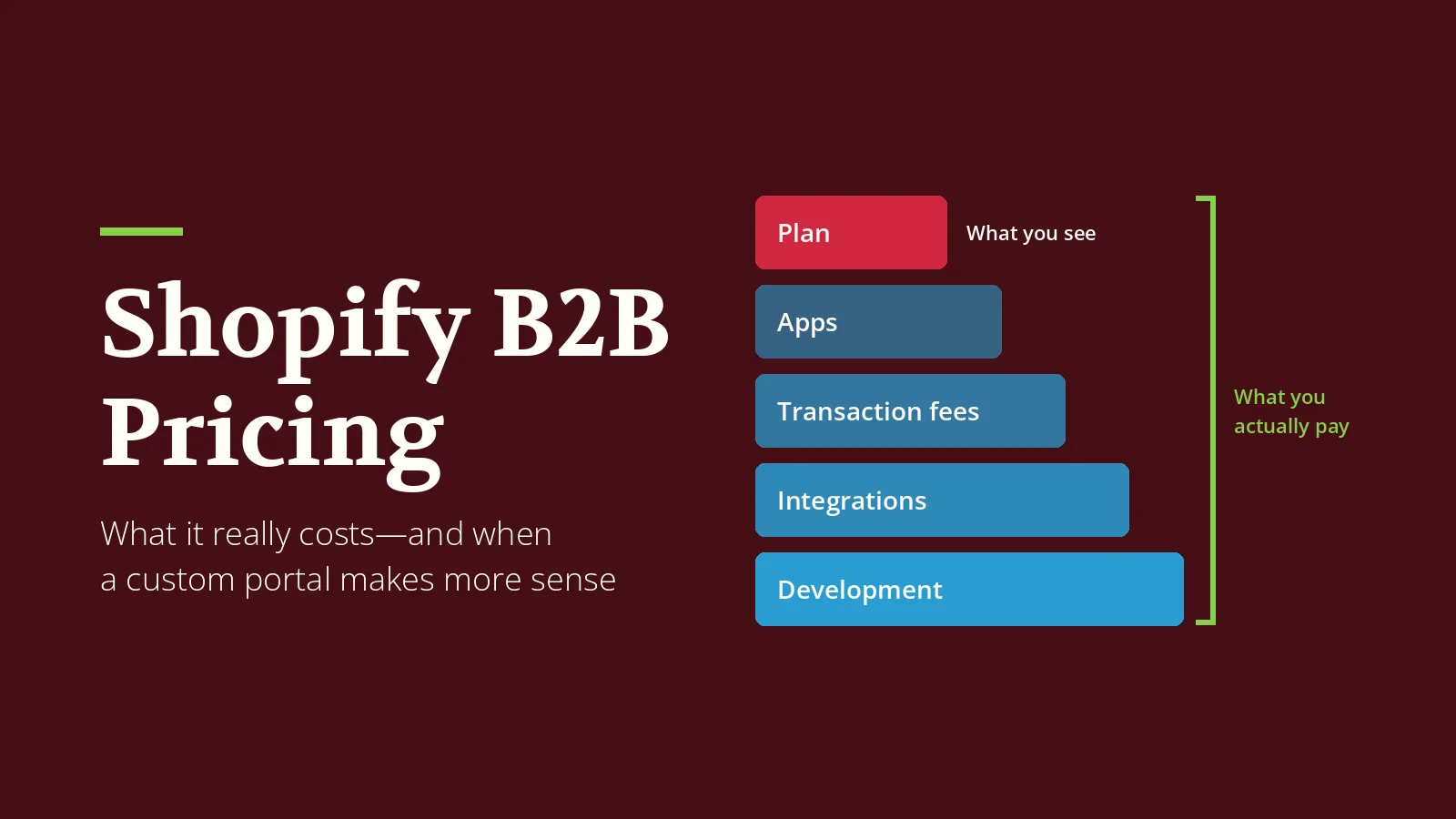
Shopify B2B pricing starts at $29 per month (billed yearly), since every paid plan now includes basic B2B features. Standard plans allow up to three B2B catalogs, assigned to groups of customers. Per-customer pricing requires Shopify Plus, starting around $2,300 per month. Apps, transaction fees, and integrations add more—so for complex pricing, a custom portal can cost less over time.
How much does Shopify B2B cost?
Shopify B2B is available with all of Shopify’s paid plans, starting at $29/month (as of Oct. 2026). For more complex B2B shops, Shopify Plus starts at $2,300 per month. When would you need Shopify Plus? If you need more complex features, like customer-specific pricing or more than three product catalogs.
Three catalogs work for simple tiers like "Wholesale," "Distributor," and "Key accounts." If more customers need custom pricing, you’ll need to pay for Plus.
How much does Shopify take from a $100 sale?
With Shopify Payments, Shopify takes the card processing fee, which is 2.9% plus thirty cents on the Basic plan. The percentage drops a bit on the more expensive plans.
While these fees don’t sound like a lot, B2B companies may feel the impact of these percentages more quickly. A $10,000 wholesale order can add hundreds of dollars in fees.
The hidden costs—apps, integrations, and development
The most expensive part of a robust B2B Shopify store is often the integrations. Even with the added payment fees and more expensive monthly plans, multiple customizations, upgrades, and developments quickly add up.
Shopify highlights its affordability, saying that its platform delivers up to 36% lower total cost of ownership—but that is specifically comparing Shopify against other commerce platforms. It does not include a custom portal build in its comparison.
For more complex B2B shops that require multiple apps and integrations, a custom build can become the less expensive option over time.
What B2B pricing can Shopify handle—and where does it cap out?
Shopify is an easy, ready-to-use commerce platform that excels when there is straightforward pricing. For B2B shops that need multiple pricing tiers, multiple commissions, and complex workflows—Shopify begins to need extras that add up fast (and are oftentimes clunky and difficult to manage).
What Shopify does well on every paid plan:
- Company profiles with multiple buyers and locations
- Payment terms like Net 30 or Net 60
- Volume pricing and quantity price breaks
- Quantity rules, like minimums, maximums, and case packs
- Custom discounts on top of wholesale prices
Where Shopify B2B price lists hit their limit:
- Three catalogs total on standard plans: The limit applies across all your B2B markets combined, not per market.
- No per-company pricing below Plus: If Company A and Company B sit in the same market, you can't give them different prices without upgrading.
- Lowest price wins: If a buyer can access more than one catalog, Shopify shows the lowest price for each product. Overlapping catalogs can quietly undercut your margins.
- Sales team complexity: Shopify doesn’t track commission rates, and custom approval chains need apps or development.
For complex B2B shops, learn how a custom portal handles multi-tier pricing and agent commissions.
What is the best B2B app for Shopify?
The best B2B app for Shopify depends on what issue you’re trying to solve. Most B2B shop apps fall under these categories:
- Wholesale pricing: Apps that accommodate multiple pricing tiers or customer-specific pricing, without upgrading to Shopify Plus
- Quotes: For companies that provide custom pricing quotes
- Order rules: For minimum order values, case packs, or reorder forms
For a company that is missing a single feature, apps can fill the gap. When you need multiple apps to fulfill a basic ordering process, you create more opportunities for disconnects and failures.
The most significant problem with apps is pricing. Each one comes with its own price tag, and that can add up over time.
Is Shopify suitable for B2B? The pros and downsides
Shopify is a ready-to-use platform that works great for simple B2B shops. If there are multiple pricing tiers, a sales team, or unique workflows, Shopify B2B becomes difficult to customize and requires third-party apps and plug-ins.
Shopify is usually enough when you have:
- Three or fewer pricing tiers
- A standard checkout and ordering process
- A manageable catalog
- No sales reps or agents paid on commission
What Shopify does well:
- Payments: cards, ACH, and stored payment methods built in
- Speed to launch: themes and setup tools get you selling fast
- App ecosystem: thousands of apps for common needs
- ERP connectors: ready-made integrations for systems like NetSuite
The downsides of Shopify for B2B:
- A steep jump from Advanced to Plus for per-customer pricing
- Dependence on apps for features B2B sellers consider basic
- Platform rules you can't change, only work around
- Ongoing transaction fees and subscriptions that grow with you
Complex B2B on Shopify still requires custom development. Shopify itself points merchants to custom apps, APIs, and headless storefronts for advanced needs. So the real question isn't whether you'll build something custom—it's whether you build on Shopify's rules or your own.
Sometimes the answer isn't replacing Shopify at all. Happy Heals sells custom-printed socks using Shopify, but its print partner needed more than Shopify Admin could handle. Arrival built a production portal with an order queue, batch printing, fulfillment, and reprint workflows—while Shopify remained the storefront.
Keep in mind that even with AI, customizing a B2B portal still requires developer expertise. Relying on AI alone to create custom tools for your B2B shop can quickly cause security risks and breaks you can't fix. Learn what AI can (and can't) do in a custom portal build.
What are your options beyond Shopify?
B2B sellers have four realistic paths. Each fits a different stage and level of complexity.
One more difference matters for some industries: visibility. Shopify now promotes AI-powered discovery, including catalogs searchable in ChatGPT. You can turn those features off, and B2B prices only show to logged-in business buyers. But keeping each customer's negotiated price visible to that customer alone still requires per-company catalogs—which means Shopify Plus.
A custom portal can be made specifically to stay private, with access and pricing set for each buyer from day one.
When does a custom portal make more sense?
A custom portal makes sense if you need customizations. Shopify can be customized by adding on different apps and integrations, but it’s a workaround. The pricing can also add up over time.
A custom portal gives you exactly what you need, without the headaches.
How Medi-Mate made the switch
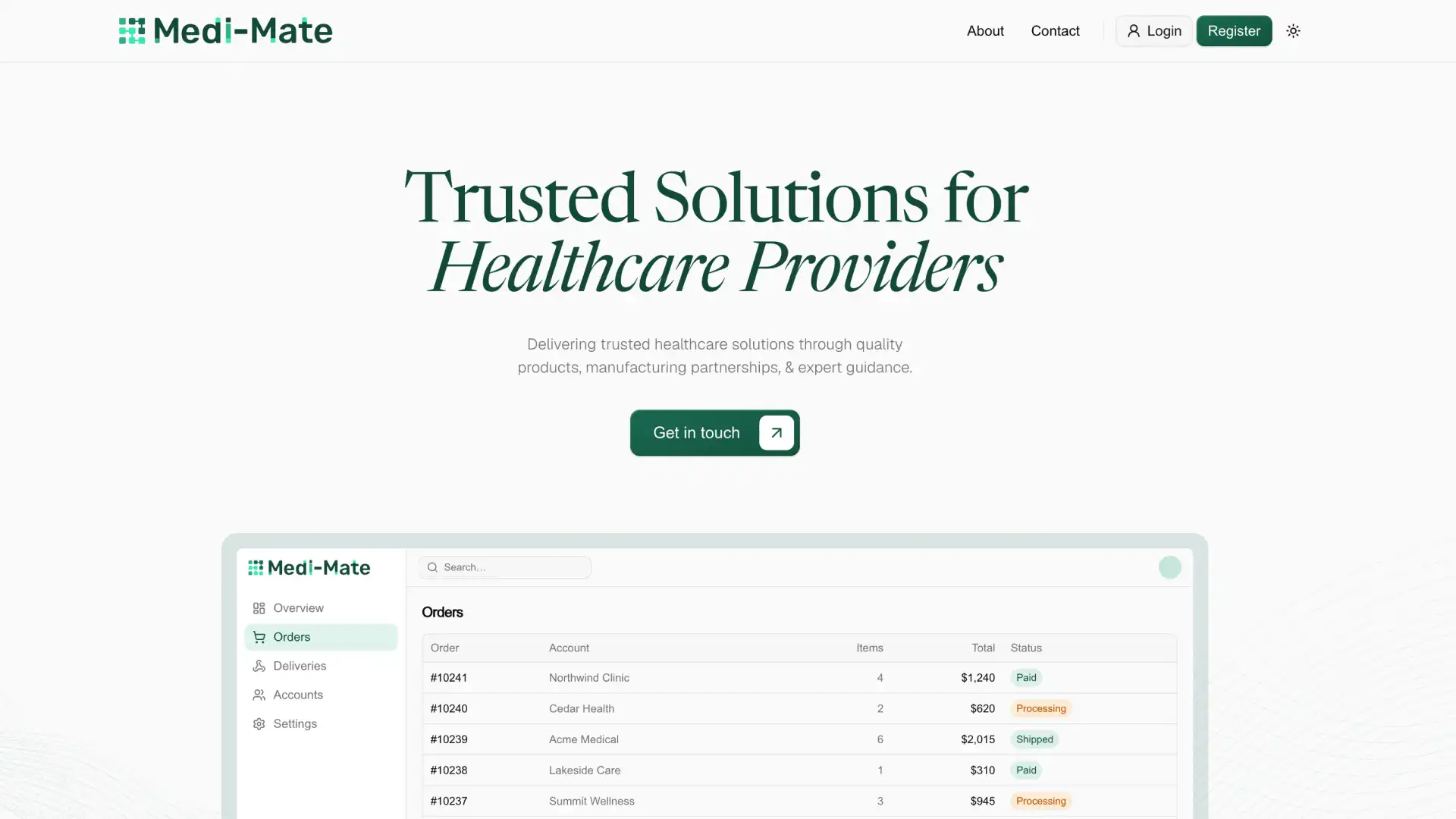
Medi-Mate's clinic-specific pricing took a manual, five-hour process every time it changed. Arrival built a custom, role-based portal that became the single source of truth for pricing, SKUs, and inventory. Leadership gained real-time revenue tracking instead of spreadsheets.
Read the full Medi-Mate case study.
Find the right fit for your B2B pricing
If you have a complex B2B shop and are looking for the best way to structure pricing, sales, or workflows, schedule time to talk with us. We can walk you through realistic options, whether it’s a custom build that integrates with Shopify—or a custom portal that does exactly what you need.
FAQ about Shopify for B2B Shops
Is Shopify B2B worth it?
Shopify B2B is a great fit for sellers with simple wholesale needs and three or fewer pricing tiers. It becomes expensive once you need per-customer pricing, which requires Shopify Plus. Add up plan, app, and fee costs before you commit.
Does Shopify have a B2B platform?
Yes. Shopify B2B is built into every paid plan as of April 2026. Standard plans include company profiles, payment terms, and up to three catalogs. Shopify Plus adds unlimited catalogs and per-company pricing.
How much does Shopify Plus cost for B2B?
Shopify Plus starts at about $2,300 per month on a standard three-year term. Most B2B sellers also pay for apps, integrations, and development on top of that.
How many B2B price lists can you have on Shopify?
Basic, Grow, and Advanced plans allow up to three active B2B catalogs across all markets combined. Shopify Plus allows unlimited catalogs, assigned directly to individual companies or locations.
Is WooCommerce cheaper than Shopify for B2B?
WooCommerce's core software is free, so it can cost less upfront. Hosting, premium wholesale plugins, and ongoing maintenance add up, though. For complex B2B pricing, the total cost often lands close to Shopify's.
Is it better to build your own B2B portal or use Shopify?
Use Shopify if your pricing is simple and you want to launch fast. Build a custom B2B portal if you need per-customer pricing, commission tracking, private catalogs, or workflows Shopify can't support without heavy customization.