


For distribution businesses that work with sales agents, off-the-shelf tools and plugins work well when your pricing is simple and commissions follow flat rates. If prices vary by account and commissions flow through multiple agents, a custom portal with built-in multi-tier pricing and agent commission software keeps everything accurate and in one place.
What is multi-tier pricing and agent commission software?
Multi-tier pricing requires the ability to customize pricing for specific groups—whether by geography, contract, customer type, or something else. If you add in commissions, pricing gets complicated, fast.
This setup is common anywhere products move through agents, reps, or dealers—including manufacturers’ reps, wholesale distributors (electronics, apparel, hardware, and industrial products), insurance agencies, and direct sales companies.
For companies that regularly deal with multiple pricing tiers and also work with reps or agents who earn a commission on sales, making updates to pricing needs to be a simple, seamless process. If you regularly calculate or update dealer pricing, tiered rates, overrides, or splits—a custom portal can help simplify pricing updates, revenue reviews, and agent commission tracking.
Why pricing and commissions belong in the same system
Many businesses track pricing in one tool, commissions in another, and sometimes use several other revenue and pricing tools that their team has to update and maintain manually. As a company grows, it's easy to see how this can quickly cause mistakes—and take ongoing, consistent maintenance.
If one integration or software fails, everything else is affected. Plus, each has its own security standards, making it vital to know exactly what information you share with each tool.
Imagine having commissions and pricing tiers in one place—one simple update could instantly synchronize updated commission rates alongside pricing changes. No more jumping between applications looking for the right info, or manually updating commission rates. As soon as you make one update, everything affected immediately aligns itself.
Signs your pricing and commission setup is breaking
If you have reps or dealers that earn commissions, it's important they are able to accurately share an updated product catalog with correct pricing. If your reps don't have easy access to up-to-date information, that creates confusion and can lead to a bad customer experience.
If updating pricing or managing agents requires time-intensive, manual processes—it may be time to consider ways to streamline those workflows.
- Pricing lives in a spreadsheet only a few people fully understand
- Agents quote outdated or wrong prices
- Your team calculates commission payouts manually—and agents may even dispute them
- Leadership can't see revenue by agent or account in real time
- New accounts or agents can take hours to manually onboard
A 2025 CaptivateIQ survey of over 200 U.S. B2B incentive compensation leaders found that 49% of surveyed businesses paid the incorrect commission amount in the last year—while only 27% fully automate their compensation process.
Can off-the-shelf software handle multi-tier pricing and commissions?
Yes, for small businesses with only a few agents, off-the-shelf tools make the most sense.
When distributors look at off-the-shelf tools, they usually evaluate two separate categories:
- Commission software that calculates payouts, like QuotaPath, Everstage, CaptivateIQ, or Salesforce Spiff
- B2B commerce platforms that handle customer-specific pricing and ordering, like WooCommerce or Shopify with pricing plugins
Each does its own job well. The problems show up when you connect them. As order volume and the number of agents grows, the disjointedness of multiple tools starts to show—and the issues become much harder to overlook.
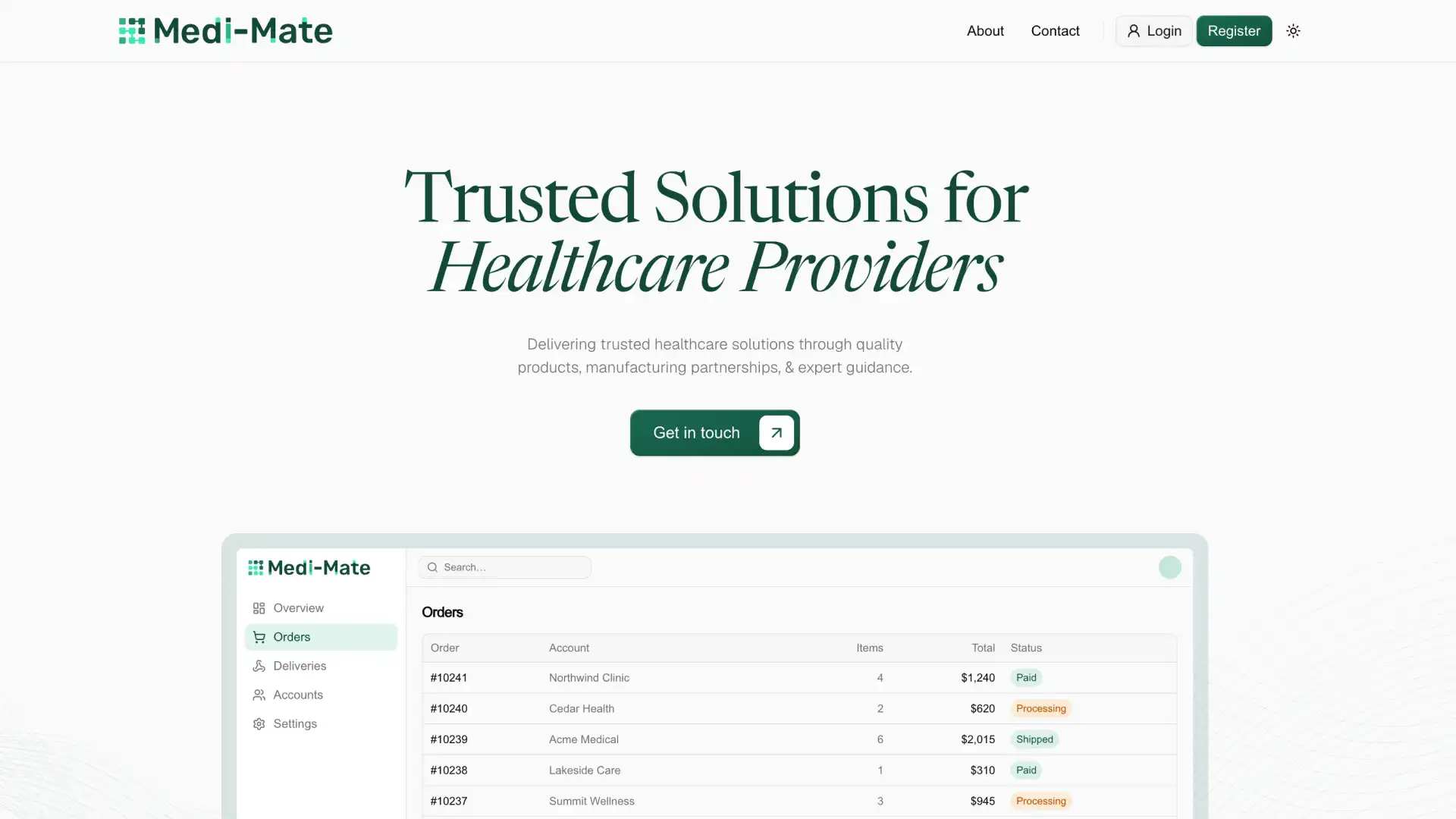
Commission tools don’t capture sales. They calculate payouts from data you feed them—through a CRM, a billing integration, an API, or a spreadsheet upload. Most distributors that sell through agents don’t track deals in Salesforce. Their sales live in an ecommerce store or order sheets. So buying commission software still means someone builds and maintains a connection from your storefront—or uploads spreadsheets every month. That gap is exactly where our client, Medi-Mate, got stuck.
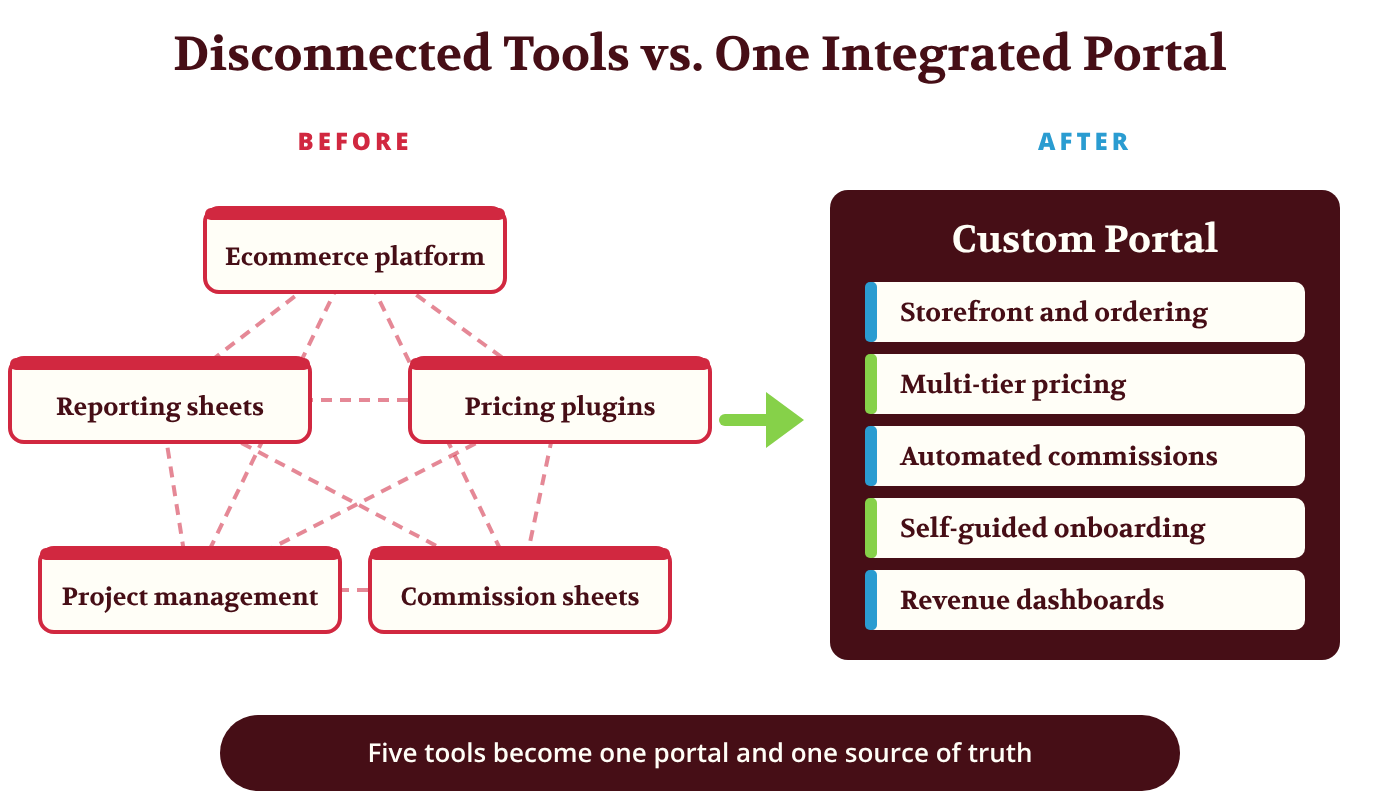
Off-the-shelf vs. custom: How the options compare
Off-the-shelf tools cost less upfront, but the bills add up. For a team of 30 agents, commission software like QuotaPath runs about $17,000–$18,000 a year (as of October 2026)—and that covers commissions only. Your storefront and pricing tools are separate subscriptions.
On the flipside, a custom build is an upfront investment. This larger upfront fee makes sense once you have enough steady revenue to afford long-term solutions.
Most companies that choose custom portals hit a point where they can’t keep up with demand—or turn down opportunities because their systems can’t support faster growth. The portal lets them focus on scaling instead of manual updates, broken integrations, and commission disputes.
Features that matter as your distributor network grows
As your distributor network grows, the features you need change. Here's what most companies start with—and what becomes essential as you add accounts, agents, and products.
How Arrival built a pricing and commission engine for a healthcare distributor
Medi-Mate, a healthcare product distributor, reached out to Arrival when they were at a critical point: their company was overwhelmed with:
- manual processes
- product catalogs not matching up across platforms
- inconsistent agent attribution across systems
At the time, their team managed pricing and commission workflows across WooCommerce, WordPress plugins, Supabase, Monday.com, and spreadsheets.
These integrations had allowed their business to take off—but were now slowing their growth.
Once we discovered exactly what they needed, Arrival built a custom portal in under two months. The portal brought pricing, commissions, and reporting into one system, including:
- Clinic-specific pricing
- An agent hierarchy with automated commission attribution
- Role-based access for staff, agents, and clinics
- Real-time revenue reporting for leadership
The immediate results of Medi-Mate's custom portal
Once the custom portal was live, client onboarding became mostly self-guided with the help of agents—something that used to require a Medi-Mate operations employee (and hours of their time for each client onboard).
Since onboarding was no longer a manual process, Medi-Mate was able to grow from 357 to 577 client accounts within 14 weeks after the portal launch.
What to define before you build
If you're interested in a custom portal, there are a lot of options, features, and tools you can choose from. It can be helpful to outline your company's long-term goals and what's needed to get there. For example, maybe your company could benefit from hands-off onboarding so your staff can provide support elsewhere. Or maybe a centralized revenue dashboard would allow you to make executive decisions with real-time information.
These are some questions to consider before building out your custom portal:
- What processes or issues are stalling your growth?
- What does your company need in order to scale?
- What information do you or your team need real-time visibility into? What up-to-date data would improve your ability to make informed, strategic decisions?
- What level of privacy and security do you need?
If you're looking for a partner to help outline the goals for your custom portal, schedule a 15-minute call with us. We can help you identify key areas where a custom portal can help your company grow—and improve workflows, accuracy, and reporting along the way.
Common questions about multi-tier agent commission software
How much does agent commission software cost?
Many commission software tools have a monthly fee of around $25–50 per user, plus the platform fee. But once you add in multiple users and capabilities, commission software like QuotaPath runs about $17,000–$18,000 a year (as of October 2026) for a team of 30 agents. Off-the-shelf software can be an affordable and accessible choice when you’re building your business—but the fees start to add up quickly as your business grows.
What’s the difference between commission software and a distributor portal?
Commission software calculates what agents earn. A distributor portal manages what customers order—product catalogs, pricing, and client accounts. Off-the-shelf, they’re usually separate tools that need integrations to share data. A custom distributor portal can handle both in one system.
Can one system handle customer-specific pricing and agent commissions?
Yes, a custom portal can set pricing for different customer groups and track agent commissions on every sale—all in one place. Most off-the-shelf setups need separate tools, plus integrations or spreadsheet uploads, to do both.
How long does it take to implement commission software?
Off-the-shelf commission software can take an average of 4–8 weeks for mid-market companies to implement. This time is spent on setup, data prep, and getting your team on board. With a custom portal, that time is primarily spent building the portal. Arrival created Medi-Mate’s custom portal in about 6 weeks and loaded its data during the build, so it was ready to use at launch.


.svg)

